I had a list of the hard words. It was wrong.
Ask around and everyone names the same suspects. MYRRH. NYMPH. EDIFY. The ones with no vowels and letters you'd swear were made up.
I believed it too, right up until I counted. Those words are among the easiest on the board, and it isn't close.
| Word | Reputation | Near-neighbours |
|---|---|---|
| MYRRH | "impossible" | 0 |
| EDIFY | "brutal" | 0 |
| NYMPH | "unfair" | 1 |
| LIGHT | ordinary | 8 |
| WATCH | ordinary | 8 |
| ROUND | ordinary | 7 |
A near-neighbour is a word that differs by exactly one letter in one position. MYRRH doesn't have any. Nothing in the dictionary looks like it, so the moment you scrape together two letters you're done.
LIGHT has eight. That's the one that ends your streak, and it walks right past you because it looks harmless.
We remember the strange words because they're memorable. That's all. Memorable is not the same as hard.
What actually goes wrong
The colours in Wordle are an information channel, and it's a good one. Green and yellow narrow the field fast.
Then sometimes it just stops.
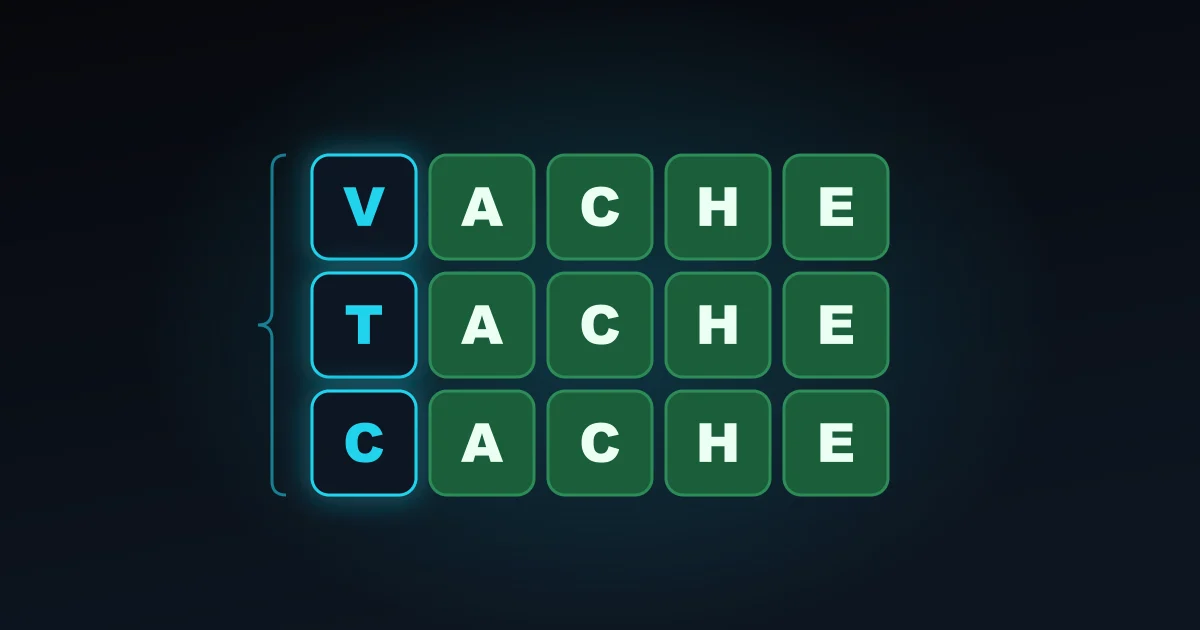
Four letters locked, three guesses gone, no progress at all. EIGHT, FIGHT, MIGHT, RIGHT, TIGHT and WIGHT are all still on the table. Every guess from here tests exactly one of them.
That's a cluster: a group of words that are all one-letter neighbours of each other in the same position. You know every word in it. Vocabulary was never the problem. The problem is that the game has stopped telling you anything, and you're now drawing names out of a hat with a hard limit on draws.
I set the line at five neighbours. Past that, six guesses isn't enough to work through them all, so I call it a trap word.
The English clusters, worst first
_IGHT is the famous one. It has company.
| Cluster | Size | Words |
|---|---|---|
_IGHT | 9 | eight, fight, light, might, night, right, sight, tight, wight |
_ATCH | 8 | batch, catch, hatch, latch, match, patch, ratch, watch |
_OUND | 8 | bound, found, hound, mound, pound, round, sound, wound |
_EARS | 7 | bears, fears, gears, hears, tears, wears, years |
15.2 % of five-letter English words are traps. Call it one in seven.
Four letters is a different game entirely. The _EAR family alone holds ten (year, near, hear, gear, bear, wear, fear, rear, dear, tear), and 47.4 % of four-letter words qualify. Nearly half the dictionary.
The tell: your greens spell a familiar ending. -IGHT, -OUND, -ATCH, -EAR. Stop guessing candidates the second you see one. There's a correct way to play that moment and guessing isn't it.
English gets off lightly
I ran the same count on French, Spanish and German, mostly out of curiosity about my own game. English came second-easiest.
| Language | 4 letters | 5 letters | 6 letters |
|---|---|---|---|
| 🇪🇸 Spanish | 65.9 % | 26.6 % | 6.4 % |
| 🇫🇷 French | 47.6 % | 19.0 % | 3.3 % |
| 🇬🇧 English | 47.4 % | 15.2 % | 5.2 % |
| 🇩🇪 German | 31.5 % | 13.8 % | 9.2 % |
Spanish is in its own category. CA_A holds twelve everyday words (casa, cada, cara, cama, caja, caza, capa, caña, caía, cava, cala, cata), and at four letters two words in three are traps.
German is the kindest, which amused me, because I'd written a piece a few months back on why German is hard to learn. Both things are true and it's the same cause seen twice. Long words, heavy morphology and few vowels make German miserable for a learner and wonderfully distinctive for a guesser.
The full four-language breakdown, including why Spanish behaves the way it does, is over here. And the gap between that first column and the last one surprised me enough that it got its own article.
The one correct move
Here's the useful bit. Inside a cluster, spend a guess on a word you know is wrong.
Everyone's instinct is to keep firing candidates. It's the worst available play. The right move is a probe: a word chosen to test several candidates at once.
_IGHT again. Your nine possible first letters are E, F, L, M, N, R, S, T, W. Don't guess NIGHT. Guess MELTS.
MELTS covers M, E, L, T and S in one move: five of the nine. A yellow E there tells you it's EIGHT. All grey kills five candidates and leaves you F, N, R, W.
The rule: load up on candidate letters, waste nothing on letters you've already confirmed. NIGHT burns I, G, H and T on positions you've already solved. MELTS burns none.
| Cluster | Candidates | Probe | Tests |
|---|---|---|---|
🇬🇧 _IGHT | 9 | MELTS or STERN | 5 of 9 |
🇫🇷 _ACHE | 10 | VOLTS | 4 of 10 |
🇩🇪 _EINE | 9 | KREBS | 4 of 9 |
One sacrificed guess turns a one-in-nine gamble into something close to certain. Two guesses spent on individual candidates do nothing of the kind.
Except at four letters, where you're stuck
The probe has a ceiling, and finding it took some of the fun out of the discovery.
At five or six letters you have room to test four or five candidates. At four, your probe is four tiles wide. These are the best ones available anywhere in each language:
| Cluster | Candidates | Best probe | Tests |
|---|---|---|---|
🇬🇧 _EAR | 10 | WITH, THEY, WHEN | 3 of 10 |
🇫🇷 RA_E | 12 | CILS, CRIS, GRIL | 4 of 12 |
🇪🇸 CA_A | 12 | TRIS | 4 of 12 |
🇩🇪 _EIN | 9 | SIND, WIRD, KIND | 3 of 9 |
Against _EAR, the strongest probe in the English language clears three of ten. Seven left, two guesses.
So four-letter mode holds the most traps and hands you the fewest ways out. When you lose there it genuinely isn't a skill issue.
Where the numbers come from
The GlyphDuel validation dictionaries: 1,025 four-letter English words, 2,335 at five, 3,180 at six, plus the same lists in French, Spanish and German. Around 25,000 words. For each one I count how many words in the same dictionary differ by exactly one letter at one position.
Two caveats worth stating. These run over the full validation lists, not the answer pools. English and French draw secrets from a smaller curated set, so real games are a bit gentler than the table suggests. And I had to rebuild the Spanish and German dictionaries before publishing any of this, because both were contaminated with proper nouns from their source corpus. Everything above is post-cleanup. That turned into a story of its own, which I tell in the language comparison.
One last thing
I haven't got better at Wordle since running these numbers. I've just stopped feeling stupid when a cluster eats my streak, and I burn a guess instead of gambling. That alone has changed a lot of games.
If one thing sticks: when your greens spell an ending you recognise, you've stopped deducing. Play accordingly.
And if you're on a bad run, switch to six letters. The word looks harder. It isn't.