I'd been giving people the wrong advice
GlyphDuel runs three word lengths: four, five and six. For months, whenever anyone asked where to start, I gave the same answer. Four letters to warm up. Six once you're comfortable.
Backwards. Not slightly. Completely.
I found out while counting something else entirely, and the numbers didn't say what I expected at all. The mode I'd been calling the gentle one punishes players harder than either of the others, in all four languages, without a single exception.
Length isn't the difficulty. Confusability is.
What makes a word hard to guess has almost nothing to do with how many letters it has. What matters is how many other words you might mistake it for.
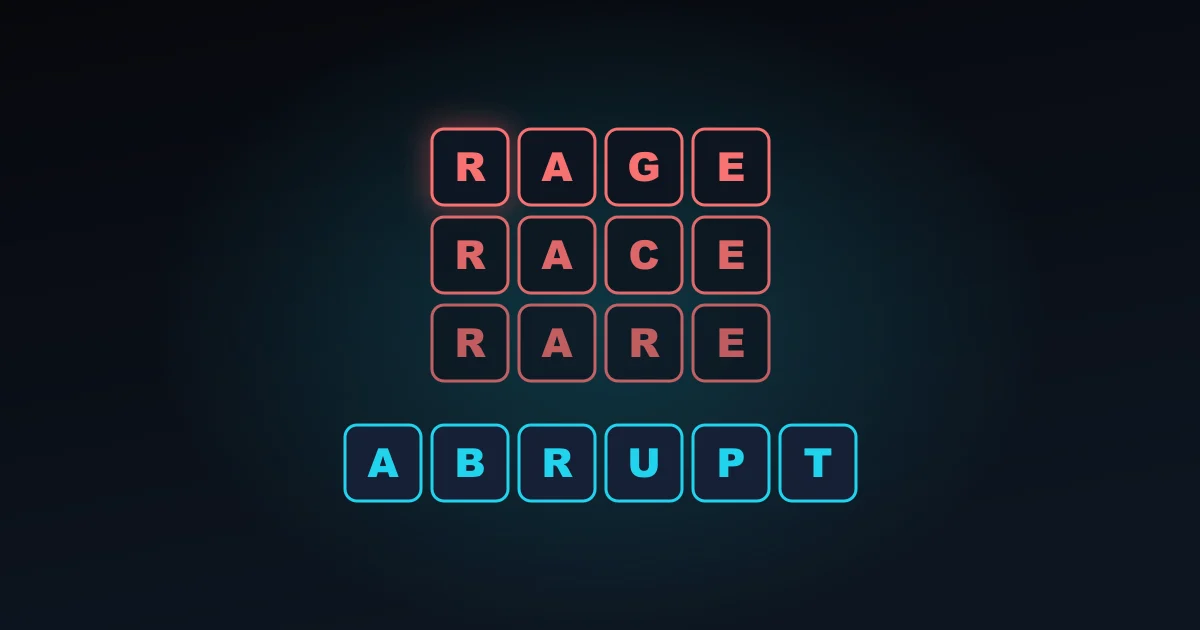
Two words are neighbours when they differ by exactly one letter in one position. CATCH and MATCH. BOUND and FOUND. A word with lots of neighbours is dangerous, because even once you've found most of its letters, several candidates survive and the colours have run out of things to tell you.
A word with no neighbours can't do that to you. Get enough clues and exactly one word fits. I've been calling these loners.
So the useful question is: how many loners live at each length?
The number that changed my mind
Percentage of words with zero neighbours:
| Language | 4 letters | 5 letters | 6 letters |
|---|---|---|---|
| 🇬🇧 English | 8.6 % | 24.2 % | 46.4 % |
| 🇫🇷 French | 8.8 % | 22.8 % | 42.9 % |
| 🇩🇪 German | 12.5 % | 29.4 % | 41.5 % |
| 🇪🇸 Spanish | 4.4 % | 11.3 % | 23.3 % |
At six letters, close to half of all English words are structurally impossible to confuse with anything. At four, fewer than one in eleven.
Same dictionary, same language, same player. Two extra letters and a word becomes five times more likely to stand alone.
The reason is geometry
Picture every word as a point in space. A four-letter word has four coordinates; a six-letter word has six. More dimensions, more room, less crowding.
In practice your dictionary holds roughly as many short words as long ones, but the short ones have to fit somewhere much smaller. They pile up, and piling up is exactly what produces neighbours.
Which gives the harsher table. Trap words are the ones with five or more neighbours:
| Language | 4 letters | 5 letters | 6 letters |
|---|---|---|---|
| 🇪🇸 Spanish | 65.9 % | 26.6 % | 6.4 % |
| 🇫🇷 French | 47.6 % | 19.0 % | 3.3 % |
| 🇬🇧 English | 47.4 % | 15.2 % | 5.2 % |
| 🇩🇪 German | 31.5 % | 13.8 % | 9.2 % |
47.4 % down to 5.2 % in English. I re-ran that one before I believed it.
Long words don't fix it, they just make it rare
Worth being careful here, because the tables above overstate the case slightly. Six letters doesn't remove clusters. It makes them uncommon.
Largest cluster found in each case:
| Language | 4 letters | 5 letters | 6 letters |
|---|---|---|---|
| 🇫🇷 French | 12 | 10 | 7 |
| 🇬🇧 English | 10 | 9 | 8 |
| 🇪🇸 Spanish | 12 | 7 | 6 |
| 🇩🇪 German | 9 | 9 | 9 |
German never lets up. Nine words in its worst cluster at every length. At six that's _EINEN: meinen, keinen, deinen, seinen, weinen, beinen, reinen, feinen, leinen.
English keeps a nasty one too. _AILED, eight deep: bailed, failed, hailed, jailed, mailed, nailed, sailed, tailed. Land in that and the extra letters buy you nothing. You just won't land in it often.
A long word isn't easier because it's more familiar. It's easier because it's rarer inside its own dictionary. Your vocabulary has nothing to do with it.
Punished twice
There's a second effect, quieter, and it compounds the first.
Stuck in a cluster, the right play is to sacrifice a guess on a word you know is wrong, picked to test several candidates at once. At five or six letters you have room to cover four or five of them.
At four letters your probe is four tiles wide. These are the best ones I could find anywhere in each language:
| Cluster | Candidates | Best probe | Tests |
|---|---|---|---|
🇬🇧 _EAR | 10 | WITH, THEY, WHEN | 3 of 10 |
🇫🇷 RA_E | 12 | CILS, CRIS, GRIL | 4 of 12 |
🇪🇸 CA_A | 12 | TRIS | 4 of 12 |
🇩🇪 _EIN | 9 | SIND, WIRD, KIND | 3 of 9 |
Against _EAR (year, near, hear, gear, bear, wear, fear, rear, dear, tear), the strongest probe in the language clears three of ten. Seven left, two guesses.
Most traps, fewest exits. That's four-letter mode.
What I tell people now
Not "start with four" any more. The opposite.
Playing for a streak? Six letters. It looks harder and it's substantially safer: 46.4 % of English six-letter words can't trap you at all, against 8.6 % at four.
Actually want the challenge? Four letters is the expert setting, and Spanish at four letters is the hardest thing on the site: 65.9 % trap words, the worst combination across every language and every length. I don't recommend it. It's there.
Multiplayer flips this, oddly. Points go to whoever solves first, so at four letters everyone falls into the same clusters and rounds get decided by luck, which quietly closes the gap between a strong player and a weak one. Six letters rewards method, so the better player wins more. If you're up against someone much stronger than you, short words are your friend.
Where the numbers come from
GlyphDuel's validation dictionaries: 1,025 four-letter English words, 2,335 at five, 3,180 at six, plus the same lists in French, Spanish and German. Around 25,000 words. For each word I count how many others in the same dictionary differ by exactly one letter at one position. Zero makes a loner, five or more makes a trap.
Two caveats. These are the validation lists, not the answer pools. English and French pull secrets from a smaller curated set, so real games run a little gentler. And the Spanish and German dictionaries needed cleaning before any of this could be published; both were carrying proper nouns from their source corpus. Everything here is post-cleanup.
One last thought
What I like about this result is that it's invisible from inside a game. You never see the words that could have trapped you and didn't. All you notice is that you lose more often at four letters, and you put it down to being tired or unlucky.
Four letters is a crowded room where nearly every word has a double. Six letters is a room where half of them stand alone.
The intimidating mode is the easy one.
If this was your kind of thing, the natural next reads are the trap words and how to escape them and which language is hardest.