I was looking for a scientist and found a cook
I sorted a 636,598-entry dump of Spanish word forms by length, expecting some medical term at the top. What came out first was achicharronaríamos: eighteen letters, meaning "we would deep-fry".
So was the second entry. And the third. The first twelve results are the same verb, conjugated through every person of every tense: achicharronábamos, achicharronaríais, achicharronásemos.
That turned out to be the most useful thing the list told me, so I am putting it before the official records. In Spanish, nouns are not what stretches. Verbs are. A regular Spanish verb generates around fifty forms, and the longest of them outrun most of the dictionary.
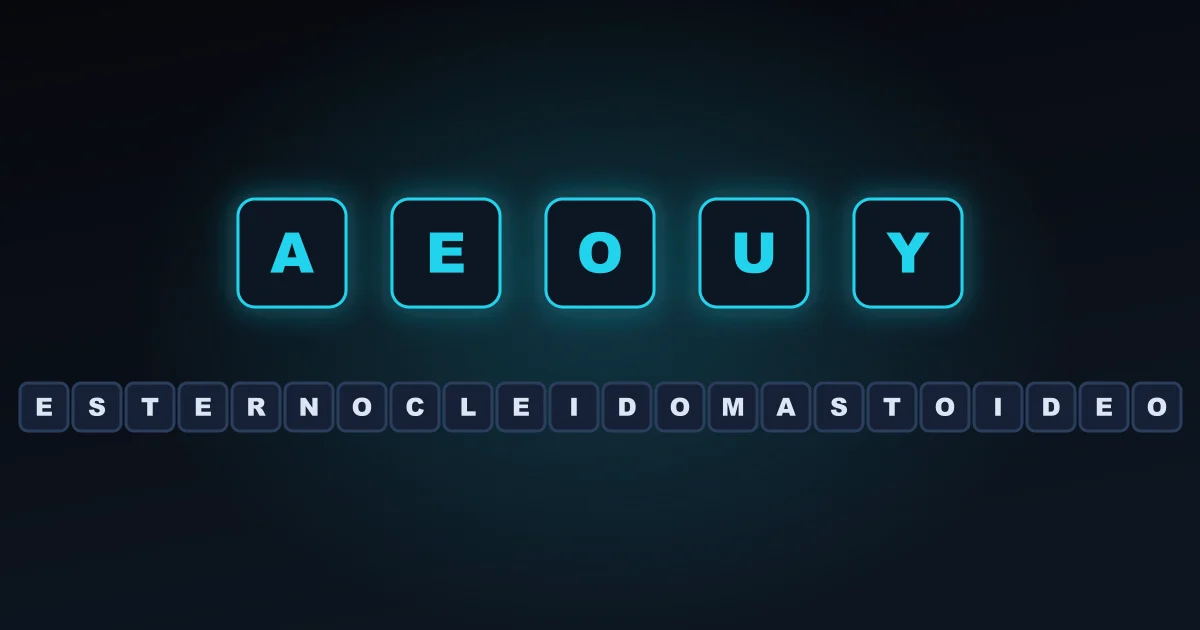
Five one-letter words, every one of them real
The other end of the scale surprised me more. English has two one-letter words (a and I). French has three if you allow à alongside a and y. German has none worth the name. Spanish has five, and all five turn up in the frequency counts for spoken Spanish, rank and all:
| Word | What it does | Rank | Share of running text |
|---|---|---|---|
| a | preposition, "to" | 4th most frequent word | 2.31% |
| y | "and" | 7th | 1.73% |
| o | "or" | 61st | 0.20% |
| e | "and" before a word starting i- or hi- | 436th | 0.023% |
| u | "or" before a word starting o- or ho- | 2,383rd | 0.0033% |
The last two are my favourites. Spanish refuses to run two identical sounds together, so y turns into e before an i sound (padres e hijos, never y hijos) and o turns into u before an o sound (siete u ocho). These are rules invented purely for the ear, and they gave the language two extra one-letter words as a side effect.
That u is the rarest word in the table: three thousandths of one percent of running text, ranked beyond two thousand. It still exists, and a Spanish speaker will place it without thinking about it.
A quarter of Spanish fits in two letters
Short words are not a curiosity at the margin. They carry the language. Here is how actual spoken Spanish breaks down by word length, measured on a subtitle corpus with occurrence counts:
One word in four is two letters long. De, no, la, el, es, en, lo, un, me, se, te, mi, sí, su, yo: fifteen words doing the structural work of the entire language.
Which means the average length of a Spanish word depends entirely on how you count. Straight off the dictionary, unweighted, it is 10.06 letters. Weighted by how often people actually say each word, it drops to 4.34. A dictionary is an inventory, not a portrait.
The real records
A dump of word forms is not a dictionary, and records need a dictionary. The Real Academia Española settles this one itself, and the answer is a single word.
The longest headword in the academic dictionary is electroencefalografista: twenty-three letters, ten syllables, a specialist in electroencephalography. Next comes esternocleidomastoideo, twenty-two letters, the neck muscle everybody has and nobody can name.
Anticonstitucionalmente also runs to twenty-three letters, and it is the popular champion, the one Spanish schoolchildren learn. Except it is not in the dictionary, and the reason is better than the trivia. -mente adverbs are an open class: Spanish mints one the moment an adjective exists, so the RAE only lists the ones with documented use behind them. The academy does record the word, but in its Tesoro de los diccionarios históricos, alongside its nineteenth-century citations, not in the working dictionary. Same machinery as English -ly, except English rarely produces anything that long.
Then there is the officially sanctioned cheat: enclitic pronouns. Spanish welds object pronouns onto the end of a verb. "Give it to me" is dámelo, one word. Entregándoselas runs to fifteen letters and is completely ordinary speech. Stack enough of them and you can build a word as long as you like without opening a medical dictionary.
Where Spanish stops
Here is the measurement I did not expect. Across all five languages, I counted the share of entries running past sixteen letters, then past twenty:
| Language | Entries ≥ 16 letters | Entries ≥ 20 letters |
|---|---|---|
| German | 36.6% | 12.3% |
| French | 2.2% | 0.1% |
| Italian | 1.7% | 0.1% |
| English | 1.6% | 0.1% |
| Spanish | 0.2% | 0.0% |
Spanish has by far the shortest tail of the five. Two entries per thousand pass fifteen letters, against more than one in three for German. The longest Spanish entry is eighteen letters; the German list reaches forty-five.
The reason is one word: Spanish does not compound. Where German fuses Kraftfahrzeug and Haftpflicht and Versicherung into a single block, Spanish says seguro de responsabilidad civil del automóvil, four words held together by prepositions. Same amount of meaning, cut differently. Long Spanish words can only come from learned derivation or from conjugation, and both of those hit a ceiling fast.
What it changes at the board
GlyphDuel's Spanish dictionary holds 1,100 four-letter words, 2,200 five-letter and 3,200 six-letter. All three lengths sit in the dense part of the language, where the everyday nouns and adjectives live.
What the distribution above does not tell you is that Spanish is still the hardest of the four languages in the game. I measured that in a separate article, and the reason has nothing to do with length: Spanish effectively plays with seventeen useful letters out of twenty-seven, which multiplies the number of words that look alike.
The two findings belong together, actually. A language whose words refuse to grow and whose working alphabet is narrow is bound to be a language where words collide.
One thing worth knowing for Spanish guesses: endings do the heavy lifting. Among five-letter words, 21.7% end in a, 20.6% in s and 18.8% in o. Three final letters cover 61% of the list. Guessing the right one on your opening word costs you almost nothing and buys you a lot.
Sources
Records come from dictionaries, distributions from my own measurements. Neither substitutes for the other.
For the records and the status of each word:
- Real Academia Española, "¿Cuál es la palabra más larga del diccionario?"
- electroencefalografista and esternocleidomastoideo in the Diccionario de la lengua española
- anticonstitucionalmente in the Tesoro de los diccionarios históricos de la lengua española, plus the RAE note on -mente adverbs explaining why it never made the working dictionary
For the measurements, two corpora doing two different jobs. Flat length counts come from the public word lists at lorenbrichter/Words, keeping 636,598 Spanish entries after filtering. These are inventories of inflected forms, which is exactly why the achicharronar family tops the length ranking: the list repeats every conjugation. Anything weighted by usage (frequency tables, ranks, the spoken average) comes from FrequencyWords, fifty thousand words with counts, built from film and television subtitles.
Two caveats. Subtitles over-represent conversational vocabulary and under-represent written registers, so the spoken average I give is probably a floor. And I normalised the way the game does, keeping ñ but stripping accents, which has no effect on lengths but explains why sí and si look identical in my tables.
One last thing
What stayed with me after all this is the u. A one-letter word, ranked beyond two thousand, whose entire reason for existing is that an o followed by another o sounded bad.
A language that stops at eighteen letters and still bothers to invent an extra word to dodge a hiatus tells you fairly clearly what it cares about.
More in this direction: letter frequency across four languages, why a four-letter word is harder than a six-letter one, and the shortest and longest words in English.