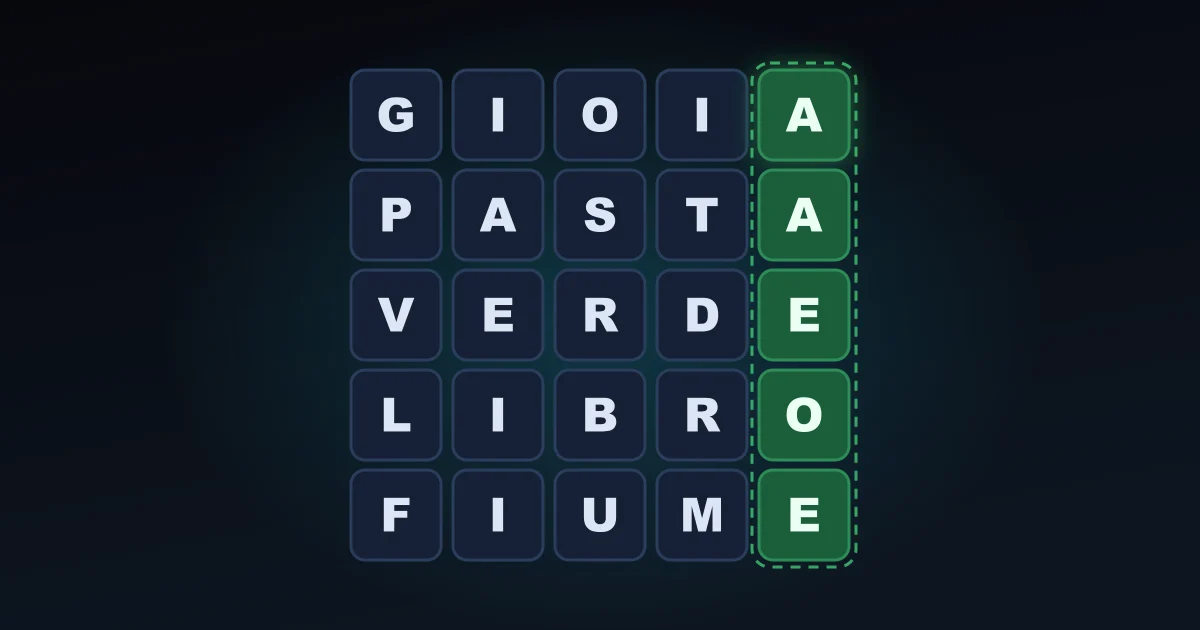
One rule, holding across 98.5% of the vocabulary
GlyphDuel does not run in Italian. The game plays French, English, Spanish and German, and I have spent enough time cleaning those four dictionaries not to open a fifth one casually.
I wanted to look anyway. So I pulled a list of 279,894 Italian words and ran the same measurements I run on the others. The first one was enough to make the question interesting.
98.5% of Italian words end in a vowel.
I knew it was a tendency. I did not know it was that close to a law.
The rule tightens as words get longer
Here is the share of vowel-final words, length by length:
| Length | Ends in a vowel | Words counted |
|---|---|---|
| 3 letters | 73.9% | 241 |
| 4 letters | 90.6% | 1,514 |
| 5 letters | 90.0% | 6,696 |
| 6 letters | 93.5% | 12,869 |
| 7 letters | 96.8% | 24,985 |
| 8 letters | 98.1% | 34,587 |
| 9 letters | 99.0% | 45,308 |
| 10 letters | 99.5% | 47,327 |
| 12 letters | 99.8% | 28,775 |
The exceptions are almost all short, and almost all either grammatical or borrowed: per, con, non, bar, film, sport. Past eight letters the Italian vocabulary is 98% vowel-final and it never looks back.
This is not an aesthetic accident. Vulgar Latin shed its final consonants on the way to Italian, where French kept them in writing and dropped them in speech, and Spanish held on to its plural -s and its verbal -n. Italian ended everything on a vowel, plurals included: libro becomes libri, not libros.
In a spoken corpus, where short grammatical words weigh far more, the figure falls to 85.9%. Which is still enormous.
Four one-letter words, and the commonest is "e"
Italian has four one-letter words, and a fifth in real usage if you count the accent:
| Word | What it does | Share of running text |
|---|---|---|
| e | "and" | 3.13% |
| a | preposition, "to" | 1.46% |
| è | "is" | 1.08% |
| i | masculine plural article | 0.54% |
| o | "or" | 0.20% |
Together those five account for 6.5% of all spoken Italian. That is the highest score among the five languages, ahead of English at 6.2% (carried by I and a) and a long way ahead of German, which has no one-letter words at all.
Worth noting: they are all vowels. The vowel-final rule applies to one-letter words too, which is mechanically obvious and still slightly funny. The language never produced a single minimal word that is a consonant.
The record, and the story attached to it
The longest word in ordinary Italian is precipitevolissimevolmente, twenty-six letters and eleven syllables, roughly "very hastily indeed". It was not born in a dictionary. Francesco Moneti built it in 1677, in La Cortona convertita, deliberately bending the rules of Italian derivation, and for a very specific reason: the word on its own forms a hendecasyllable, the eleven-syllable line of Italian verse. It was a word written to fill a line of poetry, and it fills it exactly.
The Accademia della Crusca never let it into its dictionary, which a nineteenth-century lexicographer summed up by saying the academy had "judiciously omitted" it and that one could nonetheless repeat it gracefully. Treccani does list it today. It ended up travelling inside a proverb ("chi troppo in alto sal, cade sovente precipitevolissimevolmente") and becoming a minor point of national pride, which is what sometimes happens to jokes that survive three centuries.
Longer words exist, but you have to go to the doctors and the chemists for them: psiconeuroendocrinoimmunologia runs to thirty letters, ciclopentanoperidrofenantrene to twenty-nine. Nobody ever quotes those, which is precisely why the popular record still belongs to an adverb invented to land a rhyme.
The longest genuinely unremarkable Italian words are a different animal:
| Word | Letters | What it is |
|---|---|---|
| polidesossiribonucleotide | 25 | biochemistry |
| autoblindomitragliatrice | 24 | an armoured machine-gun car |
| internazionalizzerebbero | 24 | "they would internationalise" |
| psiconeuroendocrinologia | 24 | a medical speciality |
| ortoflorofrutticoltura | 22 | market gardening, floriculture and fruit growing |
As in Spanish, a conjugated verb form turns up among the technical terms. And as everywhere, the longest word you actually meet is far shorter: among the thousand most frequent Italian words, the champion is probabilmente, at thirteen letters.
What the vowel rule would cost a grid
This is the measurement I did all of it for.
On a Wordle board, every revealed square hands you a measurable amount of information. The less predictable the letter, the more candidates finding it eliminates. The unit is the bit: one bit means halving the number of words still possible.
So I computed the entropy of the final letter across five-letter words, in all five languages:
| Language | Information carried by the final letter |
|---|---|
| English | 3.57 bits |
| German | 3.43 bits |
| French | 3.30 bits |
| Spanish | 2.95 bits |
| Italian | 2.64 bits |
Italian comes last, almost a full bit behind English. In practice: uncovering the last letter of a five-letter English word cuts the field by a factor of about twelve. In Italian, by six. The final square of an Italian grid is worth roughly half what it is worth in English.
The reason is in the split. Among five-letter Italian words the endings break down as i 25.0%, a 22.3%, o 21.3%, e 20.9%. Four vowels share 89.5% of the vocabulary, in near-equal parts. An Italian player does not deduce the final letter, they pick between four roughly equiprobable options, and the other twenty-six letters of the alphabet are dead weight in that position.
This does not mean Italian would be easier. It means the difficulty moves: an Italian grid would be played almost entirely on its first four squares, with a last square that rarely decides anything. It is the same effect that makes Spanish so hard, only more concentrated. Fewer letters genuinely in play means more words that look like each other.
The other number that would matter, if I ever built that dictionary, is volume. There are only 1,514 four-letter Italian words to work with, against 2,064 in French and 5,528 in English. Italian is poor in short words, which fits everything else here: when every word has to end in a vowel, four letters does not leave much room.
The curiosity everybody quotes
You cannot discuss Italian vowels without aiuola. Six letters, five different vowels, one consonant, and a completely ordinary meaning: a flower bed. Nothing exotic, nothing built for the occasion, and its plural aiuole is every bit as everyday.
In the same vein, gioia is five letters of which four are vowels, and so is cuoio. Try finding the German equivalent.
Sources
For precipitevolissimevolmente, its author, its date and its status as a line of verse:
- The Vocabolario Treccani entry
- The Italian Wikipedia article, which covers Moneti's 1677 coinage, the Casotti proverb, the Crusca's omission and the longer scientific words
For the measurements, lengths and endings come from the public paroleitaliane list, from which I kept 279,894 entries after normalising (lowercase, letters and accented vowels only). Usage-weighted figures come from FrequencyWords, fifty thousand Italian words with counts, built from subtitles.
The final-letter entropy is computed on the distribution of last letters across five-letter words in the flat list, unweighted by frequency, Shannon's formula in base two. Running the same numbers on the most frequent words pushes every language up, and for Italian the result is frankly unreliable: the subtitle corpus is riddled with English, to the point where y shows up as the final letter of more than 5% of "Italian" five-letter words. Those are film titles. So I kept the flat list, which contains only Italian.
One last caveat. The spoken corpus over-represents fictional dialogue: the true share of vowel-final words in written Italian probably sits somewhere between my two measurements, 85.9% and 98.5%.
So, Italian in GlyphDuel?
Not today. Four dictionaries is already a fair amount of cleaning, and I spent part of this summer repairing the ones I had.
But I am keeping what the measurement says. A language where the last square is worth half what it is worth elsewhere is not a less interesting language, it is one where the game shifts toward the front of the word. It would probably want to be played at six letters rather than five, where the vocabulary is plentiful and those four final vowels stop being the whole story.
If you came for the extremes of the other languages: Spanish, German and English.